

Implants at Caring Dental
Dental Implant Centre in Petts Wood
Dental implants are a wonderful solution for missing teeth, providing a natural look and feel that enable you to eat, speak and smile with confidence. Happily, advances in technology and techniques have made implants achievable and affordable for more and more people, including as a viable alternative to bridges and dentures.
At Caring Dental, we are delighted to have established a leading Dental Implant Centre, providing state-of-the-art oral surgery facilities and implant technology. We are especially proud to offer the expert services of our highly-regarded resident implantologist and specialist oral surgeon, Dr Bizhan Shokouhi.
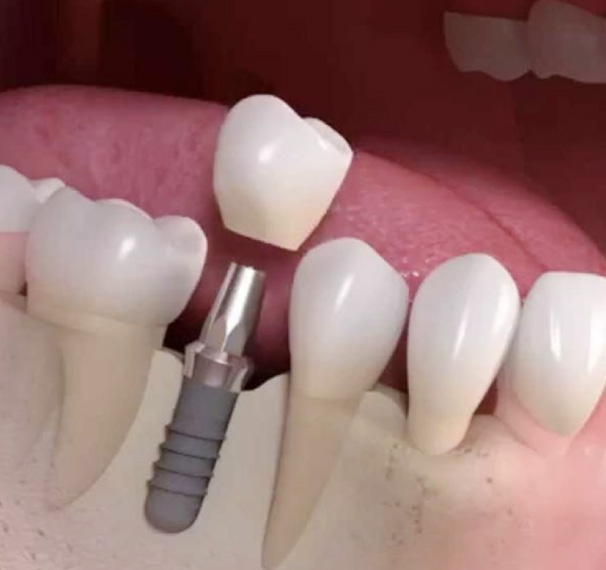
What is a dental implant?
- Dental implants are used to replace one or more missing teeth. Think of a dental implant as a small, strong support for your new tooth. It’s made of a safe material (usually titanium) and is placed in the bone where the root of a missing tooth used to be.
- Over time, the dental implant bonds naturally with the bone, creating a very strong foundation to attach a custom-made tooth. We use OptiShade digital colour-matching to ensure the crown blends naturally with your smile.
- Dental implants are used to either retain a single crown, or multiple implants can be connected together with multiple crowns, known as an implant retained bridge. Both of these are permanently fitted in place and are therefore not removable.
- Multiple implants can also be used to retain a denture. The most common situation for this is when replacing a full set (or arch) of teeth. These help make a denture more comfortable and stable, but the denture is still removable for cleaning and care.

SPECIALIST ORAL SURGEON
Leading implantologist Dr Bizhan Shokouhi
DIGITALLY GUIDED SURGERY
Precision planning and implant placement
STRAUMANN IMPLANTS
World-class Swiss-made materials, components and technology
INTRAVENOUS SEDATION AVAILABLE
Helping nervous patients feel at ease
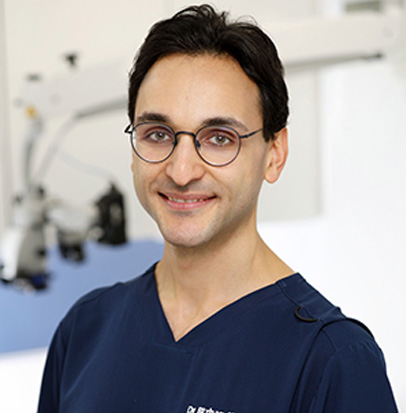
Meet our implantologist, Bizhan
Dr Bizhan Shokouhi
BDS (Hons) MJDF DipDSedDipHyp PGCert (AES) PGCAP (HE) FHEA MSc (Dental Implantology)
At Caring Dental, implants are provided by Dr Bizhan Shokouhi, a highly qualified dentist, implantologist and specialist oral surgeon who also works as a senior staff at Guy’s Hospital. Bizhan is renowned for his pioneering development of digitally guided implant techniques, and is in great demand as a mentor, trainer and speaker.
Along with his outstanding professional reputation, Bizhan is also much-loved by patients for his friendly, gentle and considerate approach, going to great lengths to provide bespoke and personalised care. As well as being equipped with the latest technology at Caring Dental, Bizhan only uses the highest quality components, including leading, world-class Straumann implants and Geistlich biomaterials, both based in Switzerland. He also works with the UK’s leading dental laboratories to create the highest quality, natural-looking crowns.
Even if you have had gaps for a long time, and previously been told you don’t have enough bone for implants, Bizhan may be able to help restore your teeth using advanced techniques. Please contact us if you are interested in a personal assessment, or use our online booking system.
To arrange a consultation, please contact our reception team on 01689 664600 or book online.
Painless implant treatment
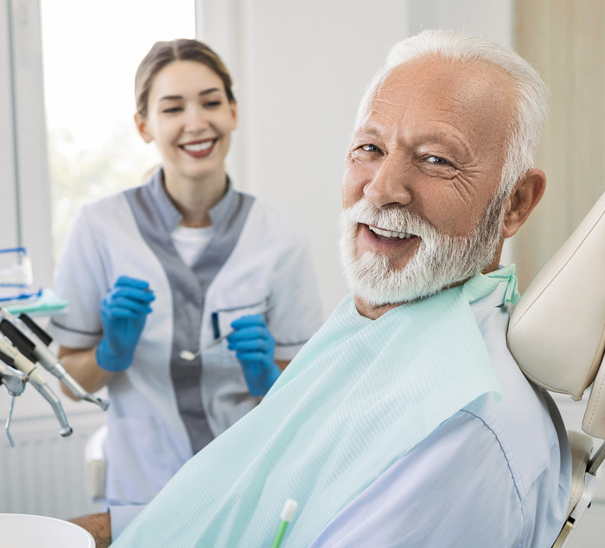
- Implant surgery may sound daunting, but people are often pleasantly surprised by how little discomfort they experience and in fact, most patients say that having an implant placed was better than having a tooth removed.
- Treatment is carried out under local anaesthetic, so you will be fully numb, and other than some movement and pressure there will not be any pain. For particularly nervous patients, we can also offer sedation.
- Of course, as with any minor dental surgery, there is some discomfort expected following the procedure, but this is manageable with over-the-counter painkillers and usually settles down quite quickly.
- Our specialists are experts in advanced techniques for treatment and recovery. Using a revolutionary Platelet-Rich Fibrin (PRF) procedure, a patient’s own blood cells are used to improve healing after dental surgery, and to help preserve bone for dental implants.
Computer-assisted implant surgery
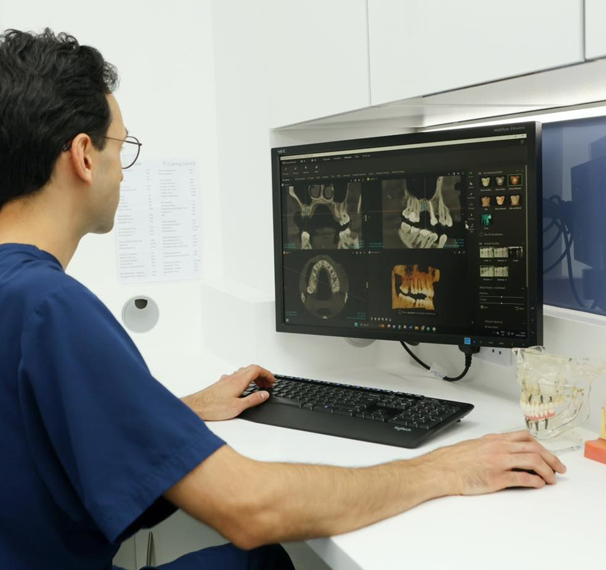
- All our dental implants are planned using the latest digital processes and surgery is carried out using 3D printed custom components.
- These use advanced software to combine data from your intra oral scan, with a CBCT 3D X-ray of the jaw, to precisely and safely plan the ideal position of the dental implant.
- This information is then used in what we call guided surgery, with a 3D printed custom component to precisely place the implant in the pre-planned position.
- This has been shown to be more accurate and predictable compared to conventional methods, and can also significantly reduce the length of surgery.
Watch dental implant video
Dental implants FAQs
Dental implants are a modern and popular way to replace missing teeth, but they may not always be the best fit for every situation. In some cases, a dental bridge may be recommended instead – it can be a quicker and more affordable solution, and still provide great results. We will assess your case individually and will provide an honest opinion of which option is in your best interest.
However, bridges do require alterations to healthy teeth, and may not provide the same level of stability as implants, which are firmly attached to the bone in your jaw. Another drawback is that bridges do not stimulate the jawbone, which over time can lead to bone loss beneath the bridge. Your dentist will be happy to discuss these considerations with you.
Sometimes, a dental implant might not be the best choice if there isn’t enough strong bone in the jaw to support it and the patient chooses not to go ahead with more advanced treatment to rebuild the bone. Certain health conditions, such as poorly controlled diabetes, can also affect the healing of implants. Smokers and heavy drinkers are also at greater risk of complications and we may advise against implants in such cases. Your dentist will invite you to discuss any health issues as part of their comprehensive assessment, so that an informed and safe decision can be made. You can find out find out more on our dental bridges page.
Dental implants are used to replace one or more missing teeth. They are an artificial replacement for a tooth root, usually made from titanium. The body forms a biological bond between the titanium surface and the jawbone, known as osseointegration. Once this has occured, the foundation to the tooth crown is inserted into the implant, usually with a screw, to which a custom made crown is attached to replace the missing tooth.
The most common reasons that people choose to replace teeth are for better eating and chewing, and for cosmetic reasons if the gaps are visible when you talk or smile.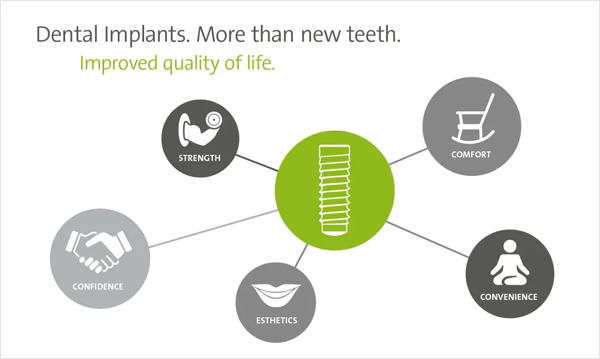
© Institut Straumann AG, 2020. All rights reserved. By courtesy of Institut Straumann AG
In addition to these points, once a tooth is removed, there are some negative biological and mechanical changes that may take place in the surrounding area. This includes the deterioration of the jaw bone (we call this resorption) and the tilting and over-eruption of adjacent teeth. Replacing teeth with implants can prevent this occuring.
In many situations yes.
The alternative options for replacing teeth are often either a bridge, or a denture.
A bridge is an artificial tooth that is attached to one or more adjacent teeth with a cement. This can involve drilling away much of the healthy tooth surface of these adjacent teeth to accomodate the missing tooth. In some situations this may be a valid option however, the long-term health of the adjacent teeth can be severely compromised and sometimes eventually resulting in losing further teeth. In contrast, replacing a tooth with a dental implant does not affect the health of adjacent teeth, and can in fact help by spreading the chewing load on other teeth.
If you have several missing teeth, a denture can be another option to replace teeth. These are false teeth that are removable. Some dentures can be designed and manufactured to be comfortable, but they will never quite feel like your own teeth due to the surface of acrylic or metal that will cover part of your gums. Also due to the inherent nature of dentures, they can move when talking or eating, and as well as causing discomfort and embarassment, this can cause damage to the surrounding teeth and underlying gums eventually. Dental implants are a fixed solution to replacing gaps, which are most like having your own teeth back.
If you have a denture, implants can be used to secure your denture in place to stop movement. Whilst you will still have a removable denture, the difference implants can make in the reduced movement of the dentures can be life changing. This is particularly the case for lower full dentures.
Of course there will be situations in which dental implants may not be the best solution in your particular case. It is not uncommon for us to tell you this and refer you to your own dentist to provide the alternative treatment that is in your best interest.
Most adults in good general medical and dental health are suitable. There is no upper age limit to having implants as long as you are physically well and do not have any significant medical problems. Younger people whose mouths and jaws may still be growing may not be suitable and usually need to wait to have implants.
Some dental factors such as significant gum disease, smoking, significant grinding/clenching and an unwillingness or inability to maintain good oral hygiene may mean that you are unsuitable for implants.
Implants also need to be inserted fully into a good volume of bone. Sometimes there has been so much bone loss that implants are just not a feasible solution to replace a tooth. This is rare. Alternatively, bone grafting or augmentation procedures are commonly carried out to replace part of the missing bone to allow adequate implant placement.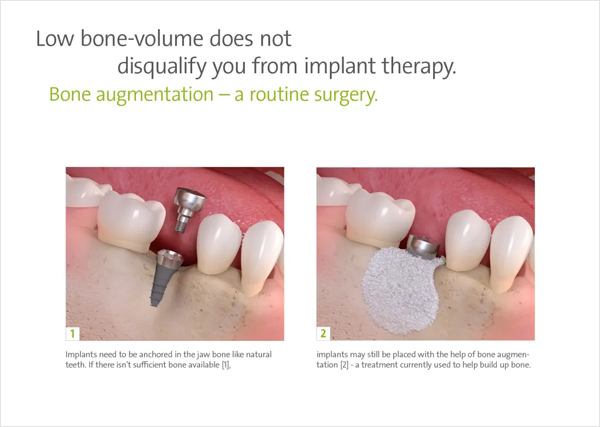
© Institut Straumann AG, 2020. All rights reserved. By courtesy of Institut Straumann AG
In general, when carried out competently by an experienced surgeon, implants will last a great many years, with current research showing over 95% survival after 10 years. This is largely dependant on individual factors and particularly how well the patient looks after their oral hygiene. Several other factors such as gum disease and significant grinding of teeth can also be bad for implants, and these will be discussed as part of your comprehensive assessment, before agreeing on treatment.
It is wrong to assume that implants last forever. Like most dental treatments, they may require maintenance or replacement.
Not really! People are often surprised how little discomfort there is during implant surgery. Treatment is carried out under local anaesthetic, so you will be fully numb, and other than some movement and pressure there will not be any pain. Of course as with any minor oral surgery, there is some discomfort expected following the surgery, but this is manageable with over the counter painkillers and settles down rather quickly.
Being fully asleep is known as a general anaesthetic. This is something that is not available in a dental practice and is only carried out in hospitals.
If you are anxious and like the idea of being asleep, we can usually carry out your treatment under intravenous sedation instead. This is a form of ‘conscious sedation’ where you are given a drug through a drip into your vein, and whilst you will not be asleep, most people are so relaxed that they often feel like they were asleep and do not often recall anything about the treatment. It is a very safe and commonly carried out procedure, even for routine treatments if someone is anxious, and we will be happy to discuss your suitability for sedation.
The cost of dental implant treatment can vary depending on the complexity of treatment. The initial cost of implants can be higher than alternative treatments however, the long-term cost-effectiveness of implants is often comparable, if not better than other options such as a bridge. The full cost of your whole treatment will be explained and confirmed in a detailed treatment plan document before agreeing to go ahead with surgery.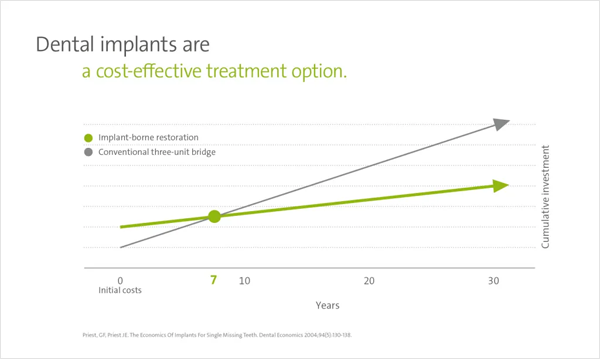
© Institut Straumann AG, 2020. All rights reserved. By courtesy of Institut Straumann AG
There are several factors that influence the cost of implant treatment, and we encourage you to enquire and ask about these with whichever clinician you decide to see.
• Are there any hidden fees? Prices that are advertised may not include the full charges for treatment, and this becomes apparent as each part of treatment is charged and quoted separately, leading to similar overall costs. For example, it is common to quote for an ‘implant’, but this does not include the cost of the actual tooth crown that is fixed to the implant. You should always receive a full breakdown of costs in a written treatment plan.
• Who is your surgeon? The success of implant treatment has been shown to be very much related to the training and experience of your surgeon – you need to know who will be carrying out all aspects of your treatment.
• What sort of aftercare will be available? This is particularly important if you are considering having treatment abroad. It is unfortunately common for patients to find themselves in a difficult situation when they require post-operative aftercare, but their original surgeon is not easily accessible to them.
• What implant system, materials and dental laboratory will be used? There are a lot of overhead costs in any implant treatment, and one way of reducing the costs to the patient is to use cheap materials and laboratories. We only use the highest quality products and trusted local UK laboratories – ones that we would choose for ourselves and families.
In very specific situations and only in some hospitals. This is usually due to the loss of teeth from cancer or trauma. If you think you may be eligible, please ask your dentist to consider a referral to a suitable local hospital department. We won’t be able to refer you or confirm whether or not you are eligible for NHS treatment, as this is assessed by specific hospital consultants.
There is no ‘best’ implant system. A quick search will give you an idea of the leading implant manufacturers that are trusted and respected.
When used competently by an experienced surgeon, most implant systems offer good results however, the quality of the components can vary with cheaper systems and importantly, the long-term availability of the parts required for servicing needs to be considered. For example, is your chosen implant system widely available and is it likely that the manufacturer will still be operating in the foreseeable future?
Straumann is a Swiss company and are considered one of the highest quality brands for dental implants. They have been manufacturing implants since 1954 and have decades of research and experience in the field. They are our first choice for ourselves and families if we required dental implants, and we choose to provide the same quality of care for our patients.
The Association of Dental Implantology in the UK provides a useful, unbiased, non-commercial patient information leaflet: Download
Of course we would love to hear from you personally if you have any queries, or if you would like to see us for a dental implant consultation.
Begin your dental implant journey
At Caring Dental, we are proud to provide modern implant techniques using the latest technology and highest quality materials. After your initial consultation, we will discuss your treatment plan with you and outline the fees. We will always be clear about costs, endeavouring to give you the best possible care, for the best possible value.
Interest-free payment options
If you would like to spread the cost of your treatment, find out more about our interest-free payment option. Our friendly reception team will be happy to help if you have questions or need assistance completing the application.