

Caring for nervous patients
Helping you feel at ease
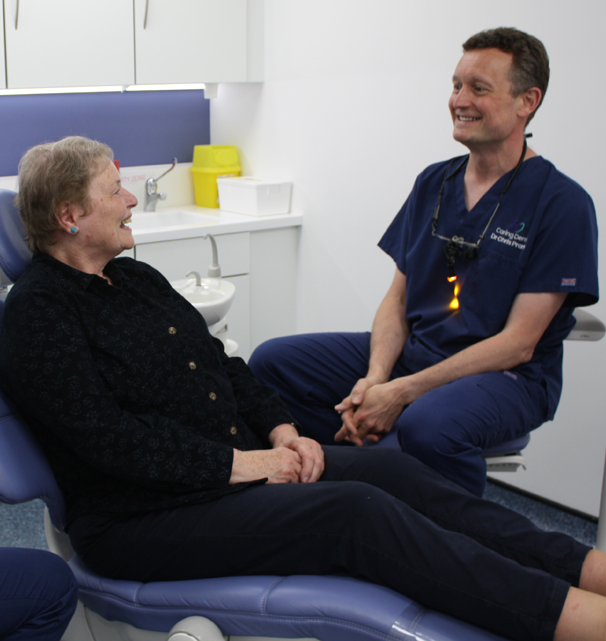
At Caring Dental we are very experienced in treating nervous patients. What’s more, if you tell us how you feel, and any concerns you have, we can prepare for your visit and make sure your time with us is as easy-going and stress-free as possible.
It’s really quite common and totally normal to be nervous, so we completely understand how you might feel. Please remember you are never judged, and there’s no need to be embarrassed or to hide any worries you have. In fact talking things through with us can be extremely beneficial, and a great relief. We’re here to help you feel at ease and to grow in confidence!
Your treatment, your choices
From the moment you step through the door to the time you leave, your experience with us should be the best you have had. We are proud that many of our nervous patients have commented in our Google reviews how relaxed they have felt and how well they’ve been looked after. We look forward to taking good care of you too!
- The most important thing is having trust and confidence. Rest assured, you are in the safest possible hands whenever you visit us. All our dentists are highly experienced, and they are also great listeners! You might like to see what our patients say about us.
- We will always do the treatment you want and at the pace you wish, explaining every step so that you remain comfortable and in control. You can ask for a break at any time. We also offer a range of options to help make your dental visits calmer and more relaxing, including music and TV.
Please see the table below for more information, and don’t hesitate to let us know if there’s anything else we could do to help.
Sedation
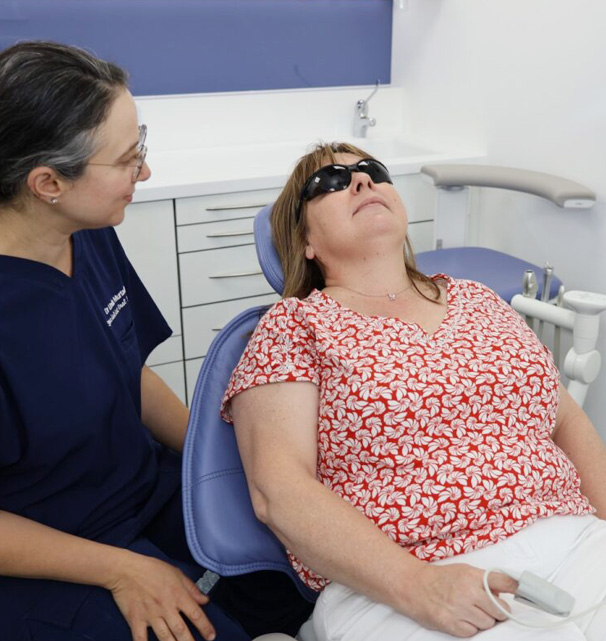
Intravenous sedation helps people feel more at ease during dental treatment, and is ideal for particularly nervous patients and for more complex procedures.
- Intravenous sedation is a form of conscious sedation, where a sedative drug is administered into a vein via a cannula, which is inserted using a very small needle. If you are severely needle phobic, your dentist will discuss options with you to help alleviate this.
- Intravenous sedation is an extremely safe and effective option, benefitting many thousands of dental patients every year. Unlike with general anaesthetic, patients remain awake in a state of conscious relaxation.
- For most people, the experience is so relaxing they feel as if they were actually asleep! Even if you are not particularly drowsy, you will feel calm and comfortable throughout. Although able to understand and respond to the dentist, the majority of patients are barely aware of their treatment, if at all, and often don’t recall anything about it afterwards.
At Caring Dental, we are experts in helping nervous patients, and have years of experience with intravenous sedation, both in practice and hospital settings. Rest assured, you will be very well looked after by your dentist and nurse.
For more information please see the FAQs below, or contact reception with any questions or to arrange a consultation.
How to feel comfortable and confident about dental treatment
Preparation
Call for a chat with our friendly receptionists, and to ask any questions about treatment.
Let us know if you’re nervous, and we’ll help you prepare for your visit.
Visit Caring Dental for a practice tour and to meet members of our friendly team.
Read our FAQs below to learn more about how we can help you. Please call us if you have any further questions!
Relaxation
Our experienced dentists have some great relaxation tips, including breathing techniques.
Listen to relaxing music with headphones or earbuds, or choose some soothing viewing on our ceiling-mounted TVs!
Chat with your dentist or nurse – conversation often aids relaxation.
We’ll keep you informed – talking through everything that is happening can work wonders!
Our dentists will take care to be extra gentle, and to do everything at a pace you’re comfortable with.
Sedation
Intravenous dental sedation is a popular, safe and effective way to remain comfortable and relaxed during treatment.
Our team is very experienced, and will listen carefully to any concerns you have, ensuring they are addressed.
Needle phobic? We can help, with options that may help to enable intravenous sedation.
Book a consultation and assessment with your dentist, to discuss sedation and safely plan your treatment. We’ll take good care of you!
Sedation FAQs
Firstly, please rest assured that you are not alone. It is rare that anyone actually likes coming to the dentist and it is estimated that at least 10-30% of the UK population has either moderate or high dental anxiety.
However, even high levels of dental anxiety can be managed comfortably when seen by an appropriate team of dental professionals. Sometimes all it takes is just an understanding dentist who will listen to your concerns and will ensure that these are addressed.
Taking care to be extra gentle and talking through everything that is happening can work wonders, and we are known to be particularly proficient at this. We also take further steps such as simply always using numbing gel to make everything as comfortable as possible.
When these measures are not enough, or if we think a treatment is particularly complex, intravenous dental sedation is a very effective and safe option for treatment.
Intravenous sedation is a form of conscious sedation using a single sedative drug.
A dose of the drug is chosen for you individually. It is given via a thin and flexible plastic tube into your vein, called a cannula. A very small needle is used to put the cannula in but is then removed immediately. It is normal to feel a sharp scratch when the cannula is inserted. Once the cannula is in the vein, the sedation drug can be given without using any more needles. The cannula remains in until the dentist has checked that you have recovered from the sedation but it will be removed before you go home.
You will remain awake throughout this procedure, so it is not the same as being asleep, which is called a general anaesthetic. However, the vast majority of patients become so relaxed that they feel like they were actually asleep and do not recall much from the whole appointment.
No. People usually prefer to have dental sedation near home as it can be more comfortable than going to a busy hospital. As long as the treatment is carried out by trained and competent clinicians, there is no absolute requirement to be seen in the hospital. We have years of experience in providing dental sedation in a practice setting and are experts at seeing nervous patients.
The best way to describe the feeling is that even though you are awake, you will essentially not care about anything that is going on because the drug makes you very relaxed and comfortable.
It is important to note that sometimes, you will not feel particularly sleepy, but you will still feel very relaxed and comfortable.
When asked, most patients say that they did not feel anything and later on cannot recall anything about the treatment. Some patients remember things more than others and there is no way to predict this.
For the vast majority of patients, intravenous sedation is extremely effective and works as described above.
In a minority of patients, the drug just does not have as much of an effect and we have no way to predict this if you have never been sedated before.
Some factors increase the likelihood of intravenous sedation not being effective. Some of these include: the use of recreational drugs, particularly cannabis, long-term use of benzodiazepine medications and some mental-health disorders.
If you are severely needle phobic and will not in any way tolerate the insertion of a cannula, then intravenous sedation alone may not be the best option. Please speak to our team to discuss alternatives.
In short, yes. We have many years of experience delivering intravenous sedation both in practice and in hospital, where more complex cases are seen.
Every year, thousands of patients in the UK receive dental treatment with intravenous sedation safely and effectively. It is much safer than a general anaesthetic, which is why it is possible to offer this treatment in a practice setting.
Some common side-effects of intravenous sedation include:
• A reduction of oxygen in the blood stream due to slowed breathing during sedation. You may be asked by your dentist/sedationist to take deep breaths to correct this. Your breathing and oxygen levels will be monitored throughout the procedure.
• Bruising at the site of the cannula. This may take several days to fade completely.
• Anterograde amnesia, which means not being able to recall events after receiving the drug. This is usually a good side-effect as patients cannot recall things that they do not want to remember and will have less anxiety for any further appointments.
Very rare risks include allergic reactions to the sedative drugs that you have been given, or vomiting during the procedure.
If there is any chance that you may be pregnant, you will not be able to have intravenous sedation due to the risks to the fetus.
You will require an initial consultation appointment to carry out a full assessment, to be able to safely plan and discuss your treatment. We will go through all the details of your treatment following this appointment.
One of the prerequisites for having treatment under intravenous sedation is being able to arrange for an able-bodied adult to accompany you to your appointment and to look after you for the remainder of that day.
As far as practically possible, yes.
However, this is dependent on individual factors and we will be happy to discuss the details of your particular case with you.
Yes, you need to at least take off the day of treatment.
Following intravenous sedation, your judgement will be affected by the drugs. This is similar to the effects of consuming alcohol. You should not drive a car, ride a bicycle or operate machinery until the following day. In some cases, this may be for as long as 24 hours. You should also not take responsibility for the care of others, use sharp implements or cook. It would be unwise to make any irreversible decisions for up to 24 hours following your treatment. Owing to the after effects of the drugs used, care should be taken when using the internet for personal communication.
Most patients are able to return to their normal work from the following day.
Being fully asleep is known as a general anaesthetic. This is something that is not available in a dental practice and is only carried out in hospitals.
General anaesthetics are only carried out where clinically necessary and not a personal choice.
You should talk to your dentist beforehand if you don’t like needles. We always use numbing gels to minimise discomfort during the injection and have several techniques to make having a dental injection really quite comfortable.
Some patients may feel uneasy about being sedated. If you feel at all worried, please speak to your dentist so they can explain what’s involved and suggest ways to help you feel comfortable. For example, your dentist will be more than happy to talk through what they’re doing at each stage or come up with a signal such as raising a hand if you want them to stop. You can take a break anytime during treatment.
Are you nervous about visiting the dentist?
Call us today and see how we can help you.
Contact our friendly team on 01689 664600 or Book Online